Friday, July 22, 2011
Lapel pins
I’ve been thinking of getting some promotional products for the upcoming fair that will help promote the business. Things that come to mind are customized lapel pins and pens to give away to the people at the fair. At the same time we’ll have some people help talk to the people about the business and how we can help them as well as the community.


Carrot growing tips
Carrots are one of the best vegies you can get kids started with in the garden. They don't take up much space, either, so even if you have only a small patch of sunny ground available, you can get a small crop of carrots growing.
Seed or seedling? Carrots (Daucus carota ssp. sativus) grow better if planted as seed where you want them to grow, but you can grow them from seedlings, too.
Sowing times: in temperate climates, you can sow carrot seed from August to March, and in cool climates from August until January. In tropical climates you can sow carrot seed from February through to November.
Preparing soil: preparing the soil before planting is important, as carrots need deep, well-drained soil that is free of rocks, stones, old roots or anything else that could get in their way. Dig the patch over really well down to the depth of a spade (about 30cm), until the soil is fine and crumbly. Add some compost and well-rotted manure, and mix that in well with the soil.
Sowing seed: to sow seed, mark little rows in the soil 6mm deep (about a quarter of an inch) scatter in the fine seed, then cover with soil or seed-raising mix. Water with a gentle spray. Tip: carrot seed is very fine, so if you mix up the seed with some dry sand and sprinkle that into the soil furrow, you'll get a better idea of where the seed is going. It will take about two to three weeks for the baby plants to emerge. As carrot seed is fine, you'll probably sow too many, so you'll need to thin out the excess seedlings. Wait until the plants are about 5cm (two inches) high, then thin them out to 2-3cm apart. Later on, when they're about 15cm high, thin them out to 5cm apart (these second thinnings are usually big enough to eat, so you end up with better value for money, and more delicious carrots!)
Sowing seedlings: tip the seedlings out of the punnet and separate them into individual plants, then plant them into well prepared soil, spacing them 5cm apart. Water in well with a gentle spray, and keep seedlings well watered until they're growing well.
General care: carrots are easy to look after and just need a steady supply of water to keep them growing rapidly.
Harvesting: carrots will be ready for harvesting about 3-4 months after sowing. If you're not sure if they are ready, just pull one out of the ground and see how it's going. Don't feel obliged to pull them all out, either. You can just harvest as many as you need that night, and leave the rest in the ground until you need them.
Problems: if your carrots come up with weird shapes, there are two common causes. One is when carrot roots strike rocks, stones, old plant roots - the carrots will bend around the obstruction and grow into strange shapes. Another cause of odd carrots is clumps of fertiliser or manure - these will cause 'forking', where the carrot splits into a clump of several roots. The other common problem with carrots is due to too much nitrogen-rich fertiliser: you end up with lots of leaves above ground, but poor roots below ground. So, a good rule with carrots is to go easy on the fertiliser.
Best varieties: seeds provide the best choice of varieties, as your choice in carrot seedlings is quite limited. Look for good performers such as 'Topweight', 'Western Red' and 'All Seasons'. For shallow soils or pots, try 'Early Chantenay' or 'Baby'. 'Manchester Table' has cylindrical roots.
Saturday, July 09, 2011
Document management system
With the business growing faster than expected I’m finding it hard to keep my documents in order. What the business needs right now is a good document management system to keep me organized. I would rather spend my time making money than organizing my paperwork so it is time to bring in some professional help to run my business. And I may have to hire a couple of helping hands too.
Currawong
The pied currawong is a large black bird, 41-51cm (16-20") with white markings on the wing, rump, undertail and tip of tail. They are found from Cape York to south-western Victoria ranging about 400km inland.
Today currawongs are common in urban areas although their native habitats are forests and woodlands.
Recent research shows that while currawongs have a specialised wild diet of bull ants and stink bugs and native berries, our introduced (not native) garden plants have provided a range of winter fruiting plants to eat during the colder months. Less than 30 per cent of Australian native plants fruit in winter, and so normally a lack of food culled younger and less vigorous birds.
Exotic plants including pyracantha, cotoneasters, privet and hawthorn - planted in the suburbs, as hedges - have tipped the natural balance in favour of the currawong by providing berries whose seeds are then excreted into native bushland.
http://wholesaleinsurance.net
I’ve always stressed that it is so very important that we have proper insurances taken up for our loved ones. Life is unpredictable and you never know when your life might take a 180 degree turn for the worst. Therefore it is good to know when things go south that the family is taken care of so go to http://wholesaleinsurance.net and get yourself insured for peace of mind.
Controlling Bitou Bush
Bitou bush (Chrysanthemoides monilifera ssp. rotundata) is a sprawling, woody shrub from South Africa. It was deliberately planted in New South Wales from 1946 to 1968 to stabilise mobile sand dunes in sand mining areas.
Unfortunately, bitou bush has proved to be a highly invasive weed, which takes over coastal ecosystems and outcompetes native plants. It is now regarded as the worst weed in the Australian coastal environment, and has recently been listed as one of Australia's Twenty Weeds of National Significance. It occurs along 660km of the NSW coast, with almost pure stands along 220km. There are concerns that bitou bush will become the dominant species within its current range, and also that it could spread into Victoria and Queensland.
Control methods
A number of control methods have been used, including hand weeding and the use of herbicides and fire. These techniques have to be repeated over several years in order to be successful in the long term, as bitou bush has a large and persistent seed bank in the soil. In conservation areas these methods are not always appropriate, and having to repeat treatments is time consuming and expensive.
Biological control
Scientists think that an integrated management approach, including the use of biological control, is the best and most cost effective way to tackle the bitou bush problem. A research program to find suitable biological control agents has been underway since 1987. Several natural enemies of bitou bush have already been released, including the bitou tip moth and the bitou seed fly, and these insects are impacting on seed production and reducing plant vigour. It's hoped that the release of a new biological control agent, the bitou leaf roller moth, will help to reduce bitou bush to a level where it is no longer a problem, or can be effectively controlled by other techniques.
Bitou leaf roller moth (Tortrix sp.)
The bitou leaf roller moth was identified in South Africa as being the most damaging insect to bitou bush. The larvae feed on the shoot tips, then move to older leaves as they mature. At high densities, they are capable of decimating plants. After extensive testing both in South Africa and Australia, the bitou leaf roller moth has been shown to be host-specific, that is it only survives on bitou bush and its close relative, boneseed, which is found in Victoria, Tasmania and South Australia. Bitou leaf roller moth was first released on boneseed in Victoria in April 2002. The first release in NSW was made at the Broadwater National Park, with others to follow along the NSW coastline.Natalie Portman's engagement ring
Did you hear? One of my favourite movie stars is engaged and it’s none other than Natalie Portman. And did you see her engagement ring? It’s so beautiful and I want to get one too! Well maybe not the same one because I wouldn’t be able to afford it but a replica maybe. So if you’re like me and love to own your own natalie portman's engagement ring then..guess what? I’m not telling so I can be the only other gal that has it!
Cane toads
Cane toads (Bufo marinus) are natives of South and Central America. They were introduced into Australia in 1935 to help control the beetles which were decimating our sugarcane crops. Cane toads were useless in controlling the cane beetles but they have become a serious threat to native wildlife, invading wetland habitats and competing with native frogs. They are voracious eaters and will eat anything they can fit in their mouths, including frogs, lizards, snakes and small marsupials. The toxic toads are also a threat to any animals that try to eat them, including domestic pets. A dog can die in just 15 minutes after eating a cane toad.
Cane toads have adapted particularly well to the Australian environment. They are spreading west towards Kakadu National Park and south into New South Wales at the rate of 30km a year. According to the CSIRO, cane toads occur at a density in Australia 10 times higher than the density in their native Venezuela. In the past two months, toads have been discovered in suburbs across Sydney where they have never been found before, and there is concern that permanent colonies will soon become established. It is thought that the toads are inadvertently being transported south in consignments of building materials and landscaping supplies.
Metal detectors
I’ve always wanted to get a metal detector so I can go fossicking for gold in the outback somewhere. Then I found out that metal detectors come in all size and price range and I’m already confused as to which one I should be getting. I think a rule of thumb is that the dearer the price the better the detector. But then the expensive ones can be as much as a few thousands dollars which I can never afford. I could go for the cheaper ones but then are they any good?
Bats in Your Backyard
Grey Headed Flying Fox
The bat is a fascinating creature that has appeared in the belief systems, art, literature, film and even recipes of people for centuries. You might not realise it, but bats will probably have visited your backyard at some stage this year. There are 966 species of bat in the world, and 90 of those are found in Australia. They come in all sizes, from a tiny Malaysian bat the size of a bumble-bee, to a huge bat from New Guinea with a wing span of almost 2 metres (6'). The fossil record shows that bats evolved as flying animals at least 60 million years ago. They are the only mammals that can fly, and the bone structure of their wings resembles that of an elongated human arm and hand. Bats are divided into two major groups, the megabats and the microbats.
Megabats
Members of the megabat group eat mostly fruit. There are 12 species in Australia including the Flying-fox, which can be seen by day hanging from branches in camps or communal roosts. At night some species fly up to 30 kilometres to their feeding areas, and some migrate as far as 1000 kilometres each year as they follow the flowering of eucalypts. There are also smaller fruit bats, for example tube-nosed bats and blossom bats. Fruit bats have sharp eyesight, and their sense of smell is so acute they can detect a tiny piece of banana from 100 metres (330') away.
Microbats
These bats eat mostly insects, they have small eyes and they rely mainly on sound (echolocation) for navigation. They are small in size and weigh from about 3-100 grams.
Thursday, June 30, 2011
Repair shop mishap
Funny thing happened to me today; I noticed that my car’s hood wasn’t closed properly. One side is shut but the other side looked like it was not closed. At first I thought someone’s hit that side of my car but I couldn’t find any dent on the panels. So I popped the hood and lord behold I found a few screws which were wedged underneath the hood when it was shut! That’s why the hood looked like it wasn’t shut properly.
I wondered how those screws got there and then I remembered taking my car to my local repair shop for the busted radiator a few months back. The mechanics must have left those old screws in there like those horror medical surgery stories you hear of surgical instruments left inside a patient’s body!
Well I like the car services I’ve gotten from this repair shop but the screws incident reflects poorly on their lack of attention and thoroughness just this one time. I think I will give them another chance and hope that is the last mistake they make with my car.
I wondered how those screws got there and then I remembered taking my car to my local repair shop for the busted radiator a few months back. The mechanics must have left those old screws in there like those horror medical surgery stories you hear of surgical instruments left inside a patient’s body!
Well I like the car services I’ve gotten from this repair shop but the screws incident reflects poorly on their lack of attention and thoroughness just this one time. I think I will give them another chance and hope that is the last mistake they make with my car.
Oleander
There are few plants which grow almost everywhere in Australia. The humble oleander (Nerium oleander), is such a plant and it is also one of the most useful of all garden plants.
If pruned correctly the oleander can be a magnificent plant, its dense foliage providing privacy where many other plants could not survive. Even on a very busy city road these plants can make a colourful screen against both noise and visual pollution. As it is dense but not woody it is also an effective road-side barrier as it should slow down a crashing car.
Oleanders are adaptable to a wide variety of growing conditions, from the salty winds of the seaside, to dry, sandy desert soils, and wetlands. They can be grown just about anywhere in Australia, preferring a well-drained, sunny position. They will manage to grow well in dry soil but cannot tolerate very wet conditions, although they like plenty of water during their main growing and flowering times.
They have a long flowering season, (summer to autumn) and a wide range of colourful varieties. The most common colour is pink, although there are also red, white and apricot flowers.
Acer laptops
I’ve been checking out new pc and laptops lately, the end of the financial year is here and if I want to get new technology for work it is now. This way I can claim it on this year’s tax instead of next year’s. So that’s why I’ve been trolling all over looking at some interesting acer laptops and tablets which caught my eyes.
Wisteria
Grown and admired in China and Japan for over a thousand years, wisteria is one of the great garden plants. These vigorous, long lived climbers like a sunny position with good drainage and reliable moisture during flowering and the initial growth period. In Australia they grow well in Perth, Adelaide, Melbourne, Hobart, Sydney and the mountains.
In China and Japan wisteria is often displayed on bamboo frames, but in Australian gardens this is not practicable. However, a pergola can easily be constructed from treated pine, which is readily available and affordable. The pergola needs to be high enough so that people can walk under it without brushing against the flowers, and wide enough so that two people can walk side by side. Wisterias can be trained to grow up a strong pole and then allowed to spread onto a few cross pieces. This creates a wonderful standard effect, which can be achieved with plants grown either in the ground or in pots. Probably one of the most famous displays of wisteria in the world is at Monet's garden at Giverny near Paris, where W. floribunda 'Shiro Noda' grows on the railings of the Japanese bridge.
Wisteria
Grown and admired in China and Japan for over a thousand years, wisteria is one of the great garden plants. These vigorous, long lived climbers like a sunny position with good drainage and reliable moisture during flowering and the initial growth period. In Australia they grow well in Perth, Adelaide, Melbourne, Hobart, Sydney and the mountains.
In China and Japan wisteria is often displayed on bamboo frames, but in Australian gardens this is not practicable. However, a pergola can easily be constructed from treated pine, which is readily available and affordable. The pergola needs to be high enough so that people can walk under it without brushing against the flowers, and wide enough so that two people can walk side by side. Wisterias can be trained to grow up a strong pole and then allowed to spread onto a few cross pieces. This creates a wonderful standard effect, which can be achieved with plants grown either in the ground or in pots. Probably one of the most famous displays of wisteria in the world is at Monet's garden at Giverny near Paris, where W. floribunda 'Shiro Noda' grows on the railings of the Japanese bridge.
In China and Japan wisteria is often displayed on bamboo frames, but in Australian gardens this is not practicable. However, a pergola can easily be constructed from treated pine, which is readily available and affordable. The pergola needs to be high enough so that people can walk under it without brushing against the flowers, and wide enough so that two people can walk side by side. Wisterias can be trained to grow up a strong pole and then allowed to spread onto a few cross pieces. This creates a wonderful standard effect, which can be achieved with plants grown either in the ground or in pots. Probably one of the most famous displays of wisteria in the world is at Monet's garden at Giverny near Paris, where W. floribunda 'Shiro Noda' grows on the railings of the Japanese bridge.
Saturday, June 18, 2011
9v batteries
My portable digital radio is the best thing since sliced bread I reckon. The sound quality is the best bar none. No more static noise and interference you get from an analogue radio, just pure sound and sweet music. The only drawback is that it goes through batteries very quickly so I have to continue swapping batteries every eight hours. Therefore I have to keep buying batteries every few days, I have a shop that I go to all the time for my batteries in my local neigborhood. They sell all sorts of batteries even the odd ones and the 9v batteries that some equipments need.
First Trip To Sydney.
Early this year in January, Terese & I took a trip to Sydney for a bit of R & R. This was my first trip there despite the fact that I've been living in Australia for 15 years! So the first thing we did when we got to Sydney was to check out the Opera House! Funny how I always though it to be white in color but not so, as you can see!
 Sydney is a beautiful city & I was kicking myself wondering why I didn't bother to visit sooner.
 Fast forward to the next day, we went sight-seeing in the city & decided to visit the chinese garden.
 We saw this cute little stone child monk & I couldn't resist rubbing his head!
 We also went up the Sydney Tower for a panoramid view of the city, in this photo you can see the tower's shadow against the park's trees.
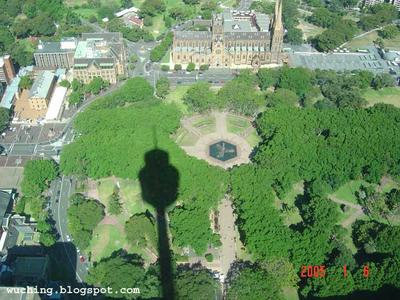 What a breath taking view!
 In the evening we went for a harbour cruise tour & the city's silhoutte with the sunset was magnificent!
 I particularly like the bright lights from Luna Park!
 On the third day, we went on a city explorer & bondi explorer buses to visit all the landmarks around town & Bondi where the sand on the beach was perfect.
 We then took the ferry across to Manly & decided if we were to live in Sydney it would be here.
 On the fourth day, we went on the harbour cruise again to see the city lines.
 We got to Watson Bay & found this really cool cliff that faces out to the ocean.
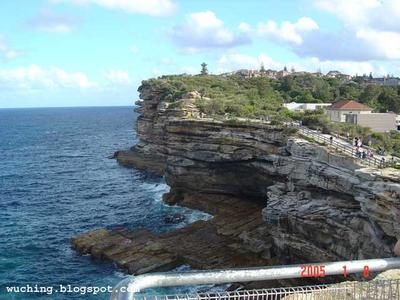 On the way back we saw the start of the Tsunami Aid Concert outside the Opera House. The next day, unfornately we had to go back to Melbourne. We want to go again!

 Sydney is a beautiful city & I was kicking myself wondering why I didn't bother to visit sooner.
 Fast forward to the next day, we went sight-seeing in the city & decided to visit the chinese garden.
 We saw this cute little stone child monk & I couldn't resist rubbing his head!
 We also went up the Sydney Tower for a panoramid view of the city, in this photo you can see the tower's shadow against the park's trees.
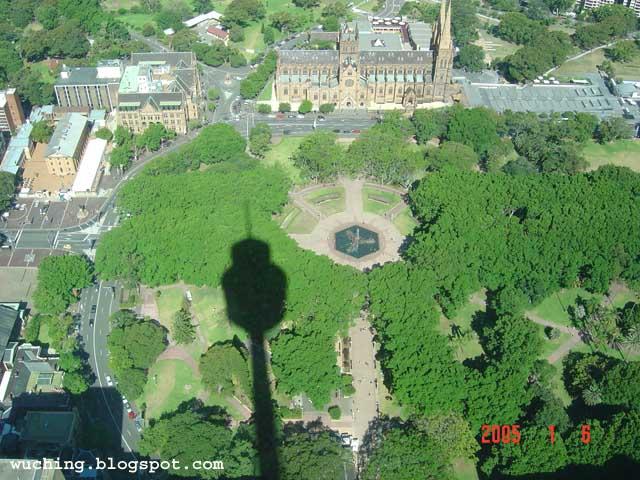 What a breath taking view!
 In the evening we went for a harbour cruise tour & the city's silhoutte with the sunset was magnificent!
 I particularly like the bright lights from Luna Park!
 On the third day, we went on a city explorer & bondi explorer buses to visit all the landmarks around town & Bondi where the sand on the beach was perfect.
 We then took the ferry across to Manly & decided if we were to live in Sydney it would be here.
 On the fourth day, we went on the harbour cruise again to see the city lines.
 We got to Watson Bay & found this really cool cliff that faces out to the ocean.
 On the way back we saw the start of the Tsunami Aid Concert outside the Opera House. The next day, unfornately we had to go back to Melbourne. We want to go again!
Wednesday, June 08, 2011
Yoga mats
Ever since we bought the wii console we’ve been on it just about every day. My favourite would have to be the yoga exercises and I must say I’m getting good at it too. Now the exercises seem to be too elementary for me. I think it is time for me to do real yoga, I need to join a proper yoga class with real instructors and proper yoga mats! I’ll be the next yogi master soon.
Red eggplants
Most people would be familiar with the large, purple-black eggplant or aubergine (Solanum melongena) which is used to make delicious recipes like ratatouille and baba ganoush. If you shop around you'll also be able to find white skinned or striped varieties, lady's fingers and the tiny pea eggplant, which is used in Asian cooking. The good news is that there are new red varieties of eggplant available, which have a better flavour than the common purple ones because they are not as acidic. They can be cut in half and put on the barbecue, or sliced thinly, fried and added to platters of antipasto.
Sunday, May 29, 2011
Invitations
I have a full schedule this month; I have so many invitations and I think I may have to decline some of them. Now I just have to decide which invitations to turn down, I hope they’ll understand. There are just not enough hours in a day for me and I’m just talking about my social life! Wait till I tell you about my work life which is even more hectic.
Subscribe to:
Posts (Atom)